Quick Answer (30 Seconds)
Chinese street food is cheap and delicious — ¥5-20 fills you up. Jianbing guozi (煎饼果子) is the king of breakfast, grilled cold noodles (烤冷面 kǎo lěng miàn) are a Dongbei favorite, stinky tofu (臭豆腐 chòu dòu fu) smells terrible but tastes amazing, and tanghulu (糖葫芦 táng hú lu) is a winter-only treat. How to tell if a stall is clean? Look at the queue — busy stalls have high ingredient turnover, meaning fresh food. Avoid raw and cold items (cold salads, pre-cut fruit), bring your own tissues, and keep anti-diarrhea meds in your bag. Don't eat at scenic spot entrances — overpriced and underwhelming. Walk two streets away for half the price. Got the runs? Don't panic — buy montmorillonite powder (蒙脱石散 méng tuō shí sàn) at any pharmacy for a few yuan.
Bottom line: A stall with a long queue is always more reliable than an empty one.
Full Guide
My first year in China, I was too scared to try street food — afraid of getting sick. Then I discovered that if you pick the right stalls, Chinese street food is the cheapest, most delicious everyday cuisine in the world. Jianbing guozi, grilled cold noodles, stinky tofu, tanghulu — every single one is worth trying.
Six Must-Eat Street Foods
- Jianbing guozi (煎饼果子 jiān bǐng guǒ zi) — The king of Chinese street breakfast. A thin crepe made from batter, an egg cracked on top, brushed with sweet bean sauce and chili sauce, then folded with a crispy cracker inside and cut into pieces. Authentic Tianjin jianbing guozi uses mung bean flour and a crispy fried dough sheet — no lettuce or ham. ¥5-10
- Grilled cold noodles (烤冷面 kǎo lěng miàn) — A Dongbei (Northeast) specialty. Cold noodles pressed flat on an iron plate, egg cracked on top, brushed with sauce, rolled with sausage and onion, then cut into sections. Sweet, sour, and spicy all at once — a midnight jianbing guozi for the soul. ¥8-15
- Stinky tofu (臭豆腐 chòu dòu fu) — Smells like a dumpster, tastes incredible. Deep-fried black tofu cubes, crispy outside and tender inside, drizzled with garlic water, chili, and cilantro. Close your eyes and take one bite — you'll understand why Chinese people queue for this. ¥10-15
- Tanghulu (糖葫芦 táng hú lu) — Winter only. Hawthorn berries skewered on a bamboo stick, coated in hard sugar shell — sweet, sour, and icy crisp. Found everywhere on northern streets in winter, ¥5-15. Now there are also strawberry, grape, and even spicy strip versions, but hawthorn is the classic
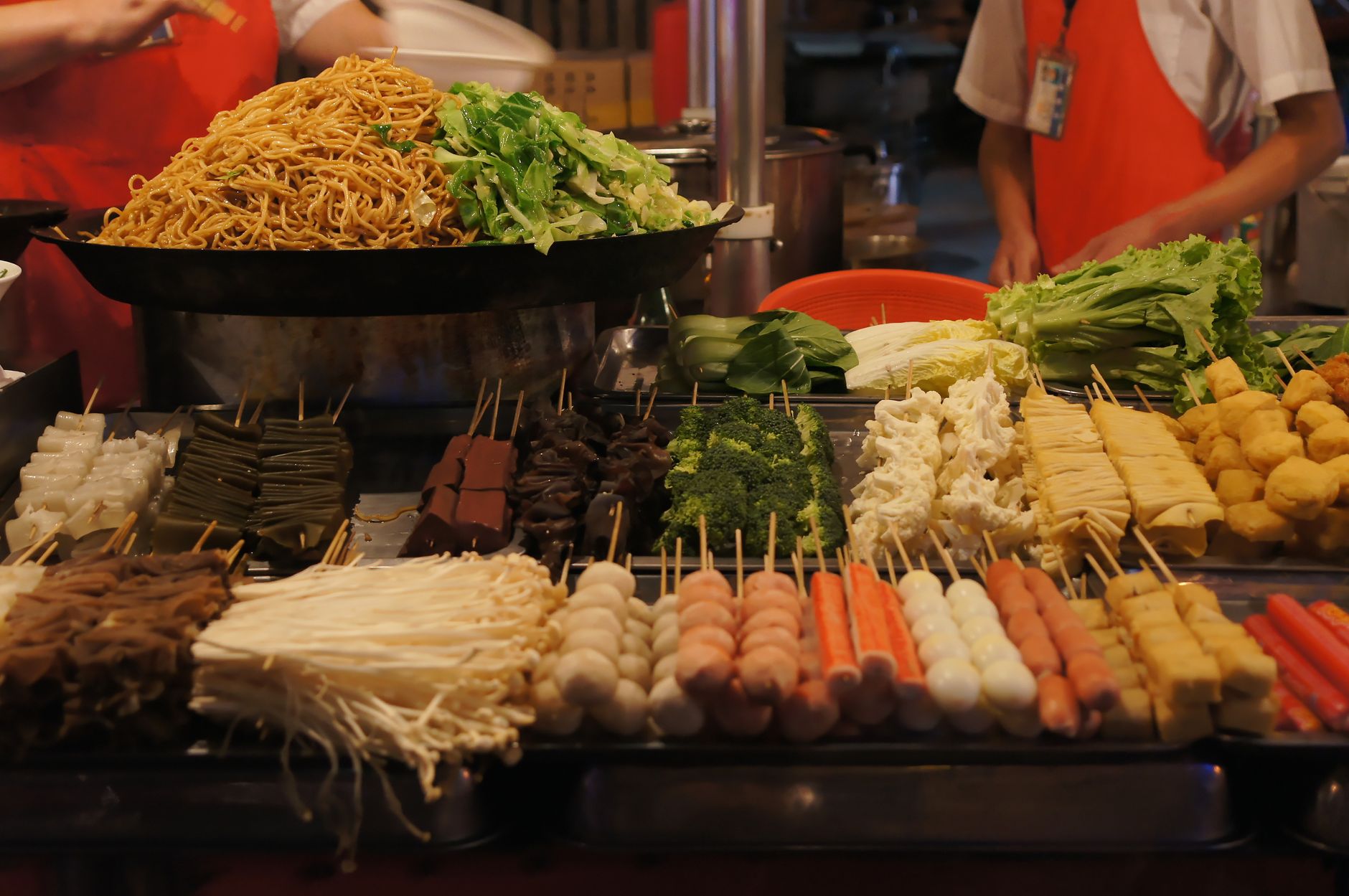
- Skewers (烤串 kǎo chuàn) — Lamb skewers, grilled gluten, grilled eggplant, grilled enoki mushrooms. Roadside stalls or BBQ joints in the evening, ¥2-5 per skewer, with ice-cold beer. Xinjiang-style skewers are the most authentic
- Roujiamo (肉夹馍 ròu jiā mó) — The soul of Shaanxi. A flatbread bun split open and stuffed with slow-stewed pork (or beef), drizzled with a bit of meat juices. Authentic Xi'an roujiamo is pure meat — no green peppers or cilantro. ¥8-15
Where to Eat: Night Markets, Snack Streets, or Roadside Stalls?
- Night markets — Chengdu Jinli, Xi'an Huimin Jie (回民街 huí mín jiē), Changsha Pozi Street — most tourists but widest variety. Prices 30-50% higher than roadside stalls, but the atmosphere is worth it. Chinese night markets typically open at dusk and run until late night or even dawn — summer nights are the most vibrant
- Snack streets — Every city has one. Ask locals "where's the street with lots of snacks?" and they'll take you somewhere tourists don't know about. Better prices, more authentic flavors. Beijing Huguosi Snack Street, Shanghai Chenghuangmiao Snack Street, Wuhan Hubu Xiang — all local favorites
- Roadside stalls — Cheapest and most authentic. Morning jianbing stands at street corners, late-night BBQ stalls at intersections. ¥5-10 fills you up, but you need to judge cleanliness (see below). No seating — eat standing or while walking. This is part of Chinese street culture
- Scenic spot entrances — Don't eat here. Overpriced and bad quality. The same bowl of noodles costs ¥30 at a scenic spot and ¥12 two streets away. High rent and one-time customers mean stall owners have no incentive to make good food
- Near universities — Food stalls around university towns are treasure troves. Students have limited budgets but discerning tastes — stall owners must be both cheap and delicious to compete. Find a university gate, follow the students — you can't go wrong
How to Judge If a Stall Is Clean
After five years of eating Chinese street food, I've boiled it down to a few iron rules:
- Check the queue — The stall with the longest line has the fastest ingredient turnover — no overnight food. A stall with 10+ people in line is generally safe
- Check the oil color — If the frying oil is dark brown and smoking black, it's been reused too many times — unhealthy. Fresh oil is light golden yellow. Walk away, don't hesitate
- Check the vendor's hands — Vendor handles money and food with the same hand? This is common at Chinese roadside stalls and most locals don't mind. If the vendor wears gloves or separates money-handling from food-handling, bonus points
- Check ingredient storage — Are raw and cooked meats stored separately? Are ingredients covered to keep flies away? Stalls with refrigeration are more reliable than those with ingredients piled at room temperature
- Check the environment — Are surfaces relatively clean? Is the trash can overflowing? Is the ground covered in oil stains? If a stall can't even wipe its tables, do you trust its food?
Hygiene Tips: Foreigner Survival Guide
- Avoid raw and cold foods — Cold salads, pre-cut fruit platters, drinks with ice cubes at roadside stalls. Ice made from tap water is a high-risk source of stomach trouble
- Choose made-to-order hot food — Jianbing guozi cooked in front of you, skewers grilled on the spot — food that goes through high-heat cooking is much safer than cold dishes
- Bring your own tissues — Roadside stalls often don't provide napkins, or give you low-quality ones. Bring a pack of tissues for wiping hands and mouth
- Carry anti-diarrhea meds — Montmorillonite powder (蒙脱石散 méng tuō shí sàn) costs a few yuan at any pharmacy. Dissolve in warm water when you have diarrhea. Also Huoxiang Zhengqi Shui (藿香正气水) — drink a vial for heatstroke or stomach upset
- Don't drink tap water — Chinese tap water is not directly drinkable. Buy bottled water (Nongfu Spring, Yibao, ¥2-3) or boil water in your hotel kettle
Regional Street Food Specialties
China is huge — every region has its own street food representatives:
- Dongbei (Northeast) — Grilled cold noodles, skewers, sticky bean buns
- Northwest — Roujiamo, yangrou paomo, grilled flatbread (烤馕 kǎo náng), niangpi
- Southwest — Douhua, bobo chicken, wolf-tooth potatoes, danhonggao
- South China — Rice noodle rolls (肠粉 cháng fěn), boat congee, offal stew, double-skin milk
- North China — Jianbing guozi, donkey meat sandwich, fried dough, zhajiangmian
Don't worry about finding them — in a new city, open Dianping app, search "snacks" (小吃 xiǎo chī), sort by distance, go to places rated 4.5+. Or just walk the streets and join the longest queue — this method works every time in China.
Price Reference
- Jianbing guozi ¥5-10
- Grilled cold noodles ¥8-15
- Stinky tofu ¥10-15
- Tanghulu ¥5-15
- Skewers ¥2-5 each
- Roujiamo ¥8-15
- One person can eat a full street food meal for ¥15-30
- Two people sharing multiple items: ¥40-60 to try five or six varieties
Disaster Manual
Disaster Scenario 1: Got Diarrhea After Eating
Problem: You ate a bowl of cold noodles at a roadside stall, and two hours later your stomach starts protesting.
What to do:
- Don't panic — most cases are mild gastrointestinal upset, not food poisoning
- Go to a pharmacy and buy montmorillonite powder (蒙脱石散, ¥5-10), dissolve in warm water. Pharmacies are everywhere — look for the green cross sign
- Drink warm water, not ice water. Eat plain congee or white rice — no more spicy or greasy food
- If diarrhea is severe, with fever or persistent vomiting, go to a hospital — most Chinese hospitals have emergency rooms. Bring your passport
- Next time, avoid stalls with cold salads — choose made-to-order hot food
Disaster Scenario 2: Stinky Tofu Overwhelmed You
Problem: You gathered your courage and bit into stinky tofu, but the taste is too intense — you almost threw up.
What to do:
- The stench is mainly in the smelling — the taste in your mouth is actually fine. Pinch your nose and try another bite
- Add extra chili and garlic water — the flavor will be much more manageable
- If you really can't handle it, don't force it. Chinese street food has plenty of other options — no need to torture yourself
- Get a cup of sour plum juice (酸梅汤 suān méi tāng) or soy milk to wash down the taste
Disaster Scenario 3: Scammed at a Scenic Spot Stall
Problem: You bought a roujiamo at a scenic spot entrance for ¥25, bit into it — all fat, and the bun is soggy.
What to do:
- Food at scenic spot entrances is universally overpriced and low quality — this is a rule. Accept it and move on
- Walk two streets away from the scenic spot, find a place with a local queue — same food, ¥10, three times better
- Use Dianping app to search nearby snacks — anything rated 4.5+ is generally safe
- Want to vent? Take a photo and post it on social media with the caption "Scenic Spot Food Trap Guide"
Information verified: August 2026 · Sources: Various city tourism department public information, Dianping food rankings · Prices vary by city and location.
The following are the author's personal QR codes (not merchant codes), with a fixed amount of ¥10.00 set for testing whether your card binding was successful.


About Personal QR Codes: This website is maintained by an individual. The QR codes are for personal daily use, not merchant codes. Since personal QR codes may not be able to accept international credit card payments, the transaction may fail. However, this does not mean your card binding failed — the fact that you reached the payment page itself confirms that your binding was successful.
About the Amount: Please do not modify the preset amount. This is simply a payment test. If the payment goes through, consider it as buying me a coffee. The fixed amount is set to avoid any inconvenience caused by accidentally entering the wrong amount.
Important: The primary purpose of these codes is to help you verify whether your registration and card binding were successful, not to generate profit. If you're not comfortable, feel free to skip this step.