Quick Answer (30 seconds)
Chinese tea comes in six categories: green, black, oolong, dark, white, and yellow — differentiated by fermentation level. Go to a teahouse to experience traditional tea culture — pick tea, brew, refill, sit all afternoon. Learn the gàiwǎn (lidded bowl) and zǐshā hú (Yixing clay teapot). Tea etiquette: fill to seven-tenths (not filling the cup is a sign of respect) and finger-tapping (tap the table with two fingers when someone pours for you as a thank-you). If traditional tea feels too formal, street-side bubble tea shops like Heytea, Nayuki, Chagee, and Mixue are what young people actually drink daily. A cup of bubble tea runs ¥6-35, a traditional teahouse ¥50-200 per person.
Full Guide
In China, tea isn't just a drink — it's a way of life. I've been here five years, going from only knowing bottled green tea to being able to tell Longjing from Biluochun, to sitting in a Chengdu teahouse all afternoon. That journey made me truly understand what Chinese people mean by "sōng chí gǎn" (松弛感 — relaxed ease). Here's your guide to drinking tea like a local, from zero.
The Six Tea Categories: A Quick Map
Chinese tea is classified into six types by fermentation level, from low to high, each with signature varieties:
- Green tea (unfermented) — The most common Chinese tea. Signatures: West Lake Longjing (Hangzhou), Biluochun (Suzhou), Xinyang Maojian (Henan). Light, fresh, and crisp — great for beginners. Brew at 80-85°C, don't scald it with boiling water.
- Black tea (fully fermented) — Chinese black tea isn't the milk-tea kind you're used to in the West — it's drunk straight. Signatures: Lapsang Souchong (Fujian), Keemun (Anhui), Dianhong (Yunnan). Full-bodied and naturally sweet, warms the stomach in winter.
- Oolong tea (semi-fermented) — Between green and black tea. Signatures: Tieguanyin (Fujian, Anxi), Da Hong Pao (Fujian, Wuyi Mountain), Phoenix Dancong (Guangdong, Chaozhou). Rich aroma, lingering aftertaste — pairs well with tea snacks.
- Dark tea (post-fermented) — The "drinkable antique" that gets better with age. Pu'er is its most famous variety, split into raw pu'er (shēng pǔ — strong flavor, powerful aftertaste) and ripe pu'er (shóu pǔ — mellow, smooth). A Yunnan specialty — many Chinese people collect pu'er tea cakes like fine wine.
- White tea (lightly fermented) — The simplest processing — sun-dried and done. Signatures: Bai Hao Yin Zhen (Silver Needle), Bai Mu Dan (White Peony, Fujian, Fuding). Light, sweet, cooling in nature.
- Yellow tea (lightly fermented) — The rarest tea type. Signature: Junshan Yinzhen (Hunan). Flavor between green and white tea.
Teahouse Experience: An Afternoon of Relaxation
Sitting in a teahouse all afternoon is China's most traditional form of leisure. Teahouse styles vary by region:
- Chengdu · People's Park Teahouse — The most down-to-earth open-air teahouse. Bamboo chairs, gàiwǎn tea, ¥15-30 per cup, sit as long as you want. Next to you, people getting ear cleanings, chatting (摆龙门阵 - bǎi lóng mén zhèn). This is the Chengdu philosophy of life.
- Beijing · Lao She Teahouse — Traditional teahouse with performances (Peking opera, crosstalk, face-changing). ¥80-200 including tea and snacks — great for experiencing old Beijing culture.
- Hangzhou · West Lake Teahouses — Longjing tea's hometown. Drink the freshest Longjing at tea farms beside the lake, ¥50-100/cup.
- Chaozhou · Gongfu Teahouse — The Chaozhou gongfu tea ceremony is the most meticulous. Small pot, tiny cups — the brewing process itself is an art form.
How to Order Tea at a Teahouse
- Choose your tea — Look at the tea menu or tea cabinet, tell the server "来一壶XX茶" (lái yī hú XX chá — I'll have a pot of XX tea)
- Brewing — The server brews with a gàiwǎn or zǐshā hú and brings it to you. The first brew is usually used to rinse the tea leaves (poured out, not drunk).
- Refill — When you finish a brew, flip the lid and rest it diagonally on the bowl. The server sees this and knows to refill (a Chengdu teahouse secret signal).
- Tea snacks — Many teahouses serve peanuts, sunflower seeds, pastries, ¥10-20 per plate.
Tea Ware: Gàiwǎn and Zǐshā Hú
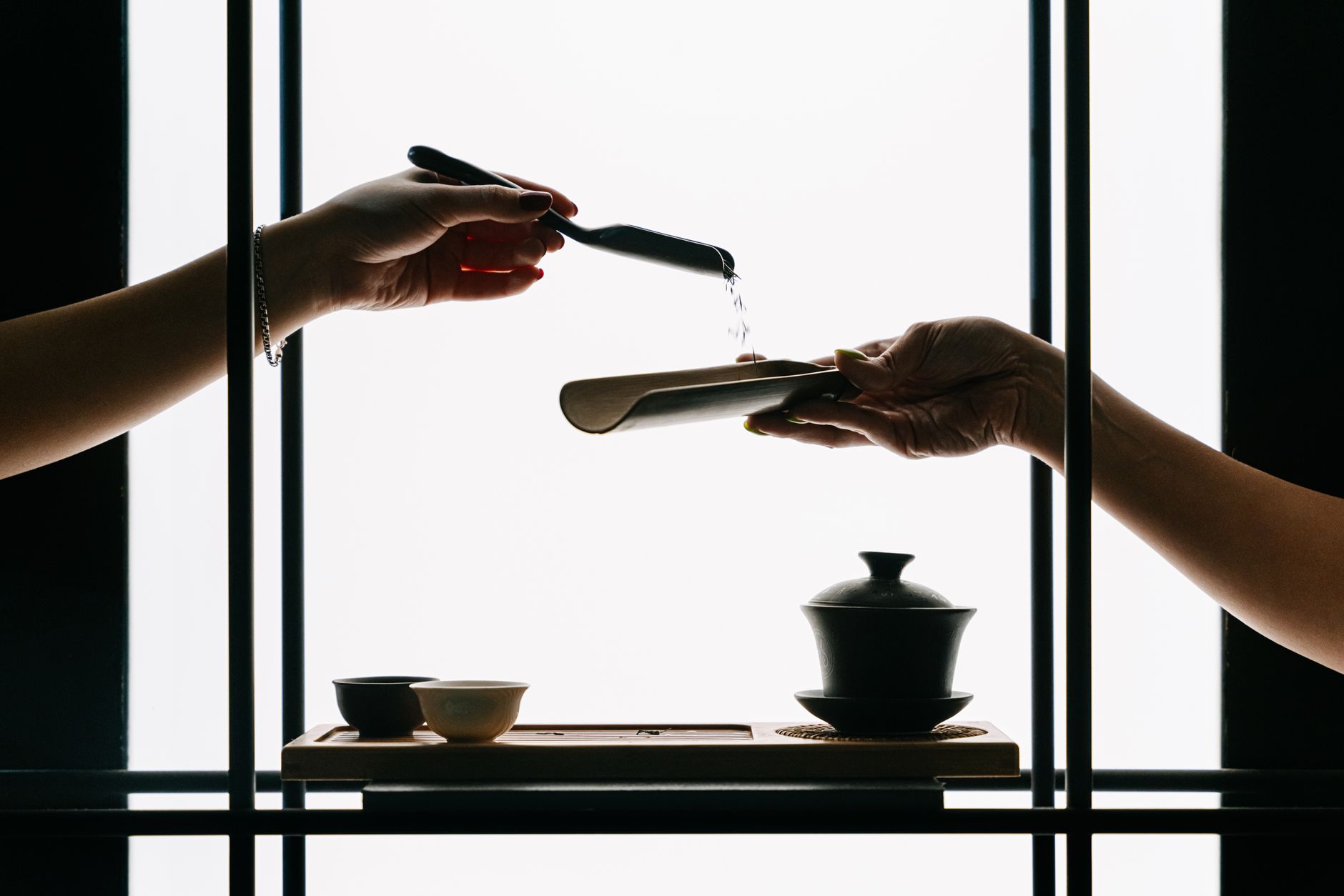
- Gàiwǎn (盖碗 - gài wǎn) — A three-piece set with lid, bowl, and saucer — China's most versatile tea-brewing vessel. The gàiwǎn lets you watch the leaves unfurl, works for all tea types. How to use: hold the saucer with your left hand, use your right hand to lift the lid and push back the leaves, sip from the rim.
- Zǐshā hú (紫砂壶 - zǐ shā hú) — A teapot made from Yixing purple clay (Jiangsu). Highly breathable, preserves the tea's flavor. Zǐshā pots "serve one tea" — one pot should only brew one type of tea, and it gets more lustrous with use. Prices range from tens to hundreds of thousands of yuan.
- Tasting cup (品茗杯) — Tiny tea cups, one sip per cup. Chinese tea is about savoring in small sips, not gulping from a big mug.
- Tea ceremony performance — Many teahouses and scenic spots have tea art demonstrations showing the full Chinese tea ceremony: warming cups → adding leaves → brewing → distributing → tasting. Beautiful to watch, but at home you don't need to be this fancy.
Bubble Tea: Young People's Tea
If traditional teahouses are the social scene for the middle-aged, bubble tea shops are the daily grind for young people. China's bubble tea market is massive, with a dizzying array of brands:
- Heytea (喜茶 - xǐ chá) — Mid-to-high end, famous for cheese-topped tea and fruit teas. ¥19-35/cup. Supports mini-program pre-ordering.
- Nayuki (奈雪的茶 - nài xuě de chá) — Similar positioning to Heytea, European-style bread + tea drinks. ¥19-35/cup.
- Chagee (霸王茶姬 - bà wáng chá jī) — Fresh milk tea focus, refreshing and not too sweet. ¥15-25/cup, growing fast.
- Mixue (蜜雪冰城 - mì xuě bīng chéng) — The king of extreme value. Lemonade ¥4, bubble tea ¥6-10. Most locations nationwide.
Ordering at bubble tea shops: scan the QR code or use the mini-program, choose sweetness level and temperature, pick up in 5-10 minutes.
Tea Etiquette: Don't Show Your Rookie
There are some unwritten rules for drinking tea in China — knowing a few is enough:
- Fill to seven-tenths — When pouring tea for someone else, only fill seven-tenths — never to the brim. The saying goes "茶满欺客" (chá mǎn qī kè — a full cup insults the guest), meaning a full cup is a signal to leave. Seven-tenths leaves room for friendship.
- Finger-tapping — When someone pours tea for you, bend your index and middle fingers and lightly tap the table twice as a thank-you. No need to stand up or say thank you — two taps is enough.
- Refill signal — At a Chengdu teahouse, flip the gàiwǎn lid and rest it diagonally on the bowl — this means "refill." The server sees it and comes to add water.
- Elders first — At a table, the host or the most senior person pours tea first.
Troubleshooting
Problem 1: Boiling Water on Green Tea = Bitter Disaster
What happens: You brewed Longjing with 100°C boiling water. The tea turned yellow and bitter, nothing like the delicate fragrance it should have.
Fix: Green tea fears boiling water — 80-85°C is the right temperature. Boiling water cooks the leaves and brings out all the bitterness. No thermometer? After boiling, let the water sit 2-3 minutes — that's roughly 80°C. For green tea, the first brew should be out in 30 seconds — don't steep too long. Add 15-30 seconds for each subsequent brew. Black tea and oolong can handle 95-100°C boiling water — no worries there.
Problem 2: Sat Too Long at the Teahouse, Getting Hints
What happens: You've been at the teahouse for three hours, and the server keeps walking past and looking at you.
Fix: Most teahouses don't limit seating time (especially Chengdu's open-air teahouses) — one cup for an afternoon is normal. During peak hours they may need the table — if it's busy, order another pot of tea or a snack as a gesture of goodwill. If you really don't want to spend more, don't be embarrassed — you paid, you have the right to sit. If they actually push you, pay and leave — Chengdu is full of teahouses.
Problem 3: Can't Read the Bubble Tea Menu
What happens: The menu is all Chinese. You don't know what "少糖" (less sugar), "少冰" (less ice), or "奶盖" (milk cap) mean.
Fix: Sweetness levels: full sugar / 70% / 50% / 30% / no sugar. Afraid of too sweet? Go with "三分糖" (30%) or "无糖" (no sugar). Temperature: regular ice / less ice / no ice / room temp / hot. Winter: "热" (hot), summer: "少冰" (less ice). "奶盖" (milk cap) is the salty-sweet cheese cream layer on top — delicious but high calorie. "鲜奶茶" (fresh milk tea) uses real milk, "奶茶" (milk tea) may use non-dairy creamer. Use a translation app to photo-translate the menu, or just pick the #1 bestseller — usually a safe bet.
Last verified: August 2026 · Sources: National standard GB/T 30766-2014 "Tea Classification", official mini-program menus of each bubble tea brand · Teahouse prices and brand menus may change.
The following are the author's personal QR codes (not merchant codes), with a fixed amount of ¥10.00 set for testing whether your card binding was successful.

About Personal QR Codes: This website is maintained by an individual. The QR codes are for personal daily use, not merchant codes. Since personal QR codes may not be able to accept international credit card payments, the transaction may fail. However, this does not mean your card binding failed — the fact that you reached the payment page itself confirms that your binding was successful.
About the Amount: Please do not modify the preset amount. This is simply a payment test. If the payment goes through, consider it as buying me a coffee. The fixed amount is set to avoid any inconvenience caused by accidentally entering the wrong amount.
Important: The primary purpose of these codes is to help you verify whether your registration and card binding were successful, not to generate profit. If you're not comfortable, feel free to skip this step.